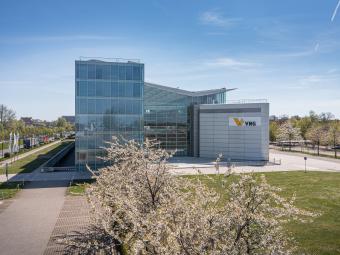
A successful 2025 financial year: VNG posts stable results in turbulent times
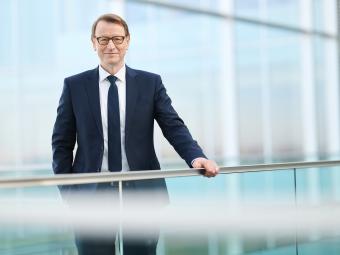
“VNG can once again look back on a successful financial year, which we are closing on a very positive note overall. Despite a challenging market environment and significant geopolitical uncertainties, VNG has maintained a stable financial performance. Our focus remains on the gas industry value chain and the operation of critical infrastructure. We ensure the security of gas supply across all our business areas,” summarised Ulf Heitmüller, CEO of VNG AG, at this year’s annual press conference.
VNG closed the 2025 financial year with an adjusted EBITDA of EUR 422 million (2024: EUR 430 million). This means that the operating profit is almost on a par with the previous year but also well above expectations. The consolidated profit attributable to the shareholders of VNG AG amounted to EUR 200 million (2024: EUR 232 million). The equity ratio rose from 33% to 41%, further consolidating the VNG Group’s very robust financial position and profitability. “Our financial strength affords us the stability we need to further develop the existing business in a selective manner, while investing in the infrastructure for renewable and decarbonised gases such as biogas and hydrogen and hence also in regional value creation. In 2025, we activated investments totalling 244 million euros across the Group – mainly in Eastern Germany and largely from our own resources,” highlighted Bodo Rodestock, VNG’s Chief Finance and Human Resources Officer. In the 2025 financial year, VNG generated invoiced revenue of around EUR 18 billion (2024: approx. EUR 16 billion). As of 31 December 2025, the VNG Group employed a total of 2,049 persons.
Ensuring a secure gas supply remains a central concern
Security of supply remained at the centre of VNG’s business activities in 2025. A secure gas supply is established by means of a broadly diversified supply portfolio consisting of dependable pipeline-based volumes and LNG imports, high-capacity storage facilities and a robust pipeline network. “Security of supply cannot be taken for granted. It is the result of forward-thinking decisions and reliable infrastructure. Our grids and storage facilities have proven their reliability even during periods of peak demand,” explained Heitmüller.
All business areas make positive contributions to earnings
In the 2025 financial year, ONTRAS Gastransport GmbH (ONTRAS) profited from higher transport revenues, partly due to additional sales. At the same time, ONTRAS is pressing ahead with the conversion of its existing gas infrastructure. As part of the Germany-wide core hydrogen network, ONTRAS will be responsible for around 600 kilometres of hydrogen pipelines with its ONTRAS H2 Start network. Around 80% of the network requires the conversion of existing natural gas pipelines, while the remaining 20% is newbuild. The contribution of the transport sector to the overall result was in the lower three-digit million range.
The key account and trading businesses made significant contributions to the performance of the Trading & Sales business area. VNG Handel & Vertrieb (“VNG H&V”) supplies over 400 customers, primarily municipal utilities, distributors, industrial customers and power stations. In addition to the domestic market, natural gas is also supplied to Poland, the Czech Republic and Austria as well as a wide range of European trading hubs. VNG H&V and its subsidiaries also supply electricity, certificates and biomethane. The diversified supply portfolio – including piped gas supplies from Norway and Algeria as well as LNG procurement via FSRU terminals – remained stable in 2025. Gas sales totalled around 411 billion kWh in the 2025 financial year (2024: approx. 352 billion kWh). goldgas GmbH’s retail business made a contribution to earnings in line with expectations. The biomethane trading business was further strengthened through bmp greengas GmbH and has been integrated into the overall strategy. In total, the Trading & Sales business area generated a profit in the low three-digit million range.
In the Storage business area, market conditions deteriorated, with factors such as narrower summer-winter spreads creating a challenge in terms of sales. At the start of 2025, during a period of very high energy withdrawals from storage facilities due to cold weather, the importance of high-capacity storage facilities as a stabilising factor within the energy system was once again demonstrated. “Our underground gas storage facilities ensure a secure supply during periods of peak demand and provide gas at short notice when it is needed,” noted Heitmüller. With a total capacity of around 31 TWh across four sites, VNG Gasspeicher GmbH continues to play a central role in assuring security of supply. In terms of operating performance, the Storage business area generated an adjusted EBITDA in the upper mid-double-digit million range.
As part of its growth strategy, BALANCE Erneuerbare Energien GmbH (“BALANCE”) has been significantly strengthened through its partnership with the infrastructure investor CVC DIF and has been able to build on its market position as one of Germany’s leading biogas plant operators. BALANCE currently operates biogas plants at 40 sites in Northern and Eastern Germany. With an installed thermal input capacity of around 241 MWTIC (2024: around 197 MWTIC), it is estimated that more than 227,000 households can be supplied with climate-friendly energy (TIC = thermal input capacity). “For VNG, biogas remains a systemically important and, above all, flexible and regionally produced energy carrier that combines security of supply, value creation and climate protection,” said Hans-Joachim Polk, VNG’s Chief Infrastructure and Technology Officer. Despite a challenging market environment – marked by selective declines in demand for biomethane – this business area contributed a profit in the low tens of million range.
The Digital Infrastructure business area performed well. VNG is investing specifically in fibre optic expansion and the predominantly regionally focused infrastructure service business. This business area made a contribution in the low double-digit million range to the overall result and contributes to the diversification of the VNG Group’s business portfolio.
Measured approach to the energy transition: biogas, hydrogen and infrastructure
VNG is pushing forward with the transition to renewable and decarbonised gases with determination, while maintaining a sense of proportion and a focus on cost-effectiveness. Biogas remains a central factor in the equation. As part of this process, the biogas plant portfolio was expanded and further developed, regional value creation was reinforced and the product range in the biomethane sector was diversified.
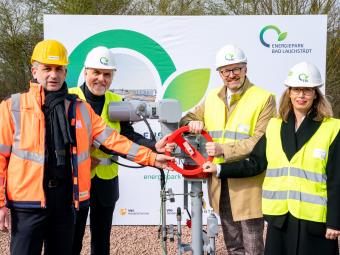
As part of the transition to renewables, VNG is also contributing to the step-by-step roll-out of a hydrogen economy. The Bad Lauchstädt Energy Park, developed in collaboration with six consortium members, is the first time the entire green hydrogen value chain has been modelled on an industrial scale. In 2025, other milestones were passed in this area: ONTRAS commissioned a 25-kilometre-long transmission pipeline, which also forms the first section of the Hydrogen Core Network in Eastern Germany. Work also began on installation of the stacks for the 30 MW electrolyser and on the phased commissioning of the entire plant. The first green hydrogen is set to start flowing to Leuna as early as 2026. In future, around 2,700 tonnes of this renewable energy carrier, generated from regional wind power, will be fed into the grid each year, transported to the anchor customer, TotalEnergies Raffinerie Mitteldeutschland, and used for industrial purposes. “We are early movers in the hydrogen market – with all the opportunities and risks that entails. However, the roll-out is currently proceeding at a much slower pace than originally planned. This is why we always carefully assess investments aimed at implementing our ‘VNG 2030+’ strategy in terms of regulatory certainty and economic viability,” said Heitmüller.
In the long term, however, Germany will not be able to meet its demands for hydrogen through domestic production via electrolysis alone. VNG is therefore working with international partners to develop hydrogen projects to supply customers with hydrogen via the emerging pipeline network and help reduce CO2 emissions. Accordingly, VNG is working with partners to examine international value chains, including the possibility of shipping ammonia to Rostock for conversion to hydrogen there. In parallel, another project is assessing the decarbonisation of Norwegian natural gas. “The Hanseatic City of Rostock offers ideal conditions for making a significant contribution to the scaling up of hydrogen production for the mass market: with its port, the existing infrastructure and also the planned connection to the Hydrogen Core Network,” explained Polk.
In addition, VNG is exploring possible options in the area of carbon management. “Along with market partners, we are currently assessing the feasibility and market potential of technological approaches aimed at reducing unavoidable CO2 emissions. However, we also need a stable, capital-market-friendly framework for CCS and CCU in this area in order to stimulate investment and mitigate risks. This includes the CO₂ transport infrastructure, competitive transport charges – including specifically for energy-intensive emitters in Eastern Germany – as well as CO2 storage projects,” Polk continued.
Outlook: Ensuring stability, pursuing a clear growth strategy and continuing the energy transformation
Heitmüller summed up the prospects for 2026 as follows: “We want to continue to grow – both in our existing business and in our future growth areas. However, in order to initiate the necessary investment in existing infrastructure and the gradual roll-out of hydrogen, biogas and, in the longer term, CCS, we immediately need reliable and workable policy frameworks. VNG will continue to actively pursue this path – with a clear phased approach that mitigates risks, focuses on cost-effectiveness and ensures our ability to act.”
In the interests of securing the long-term industrial future, competitiveness and regional value creation of Eastern Germany, Heitmüller concluded by urging: “As systemically important regional pillars of security of supply, biogas and biomethane require secure access to the gas network and less bureaucratic certification rules.” Heitmüller set out the requirements for a successful hydrogen roll-out as follows: “There is also a need to revise the criteria for electricity procurement, to reform grid tariffs in a way that does not place an undue burden on electrolysers and safeguards their economic viability, and to provide reliable demand-side incentives such as fully funded climate protection contracts and a stable GHG quota. Only through political realism can the transformation, stability and security of supply in Eastern Germany be reconciled and made resilient in the long term.”
VNG is a group of over 20 companies active in the European energy industry with around 2,000 employees. Headquartered in Leipzig, the group is a gas importer and wholesaler as well as an operator of critical gas infrastructure in the areas of natural gas transport and storage, ensuring a secure energy supply in Germany. With our commitment, projects and investments for the market ramp-up of renewable and decarbonised gases such as biogas and hydrogen, we are also creating new perspectives, actively driving change in the energy sector and strengthening our home region. Dependable, approachable and always moving. VNG – Energy. On the move.
Press picture

Financial information
Here you will find the current key financial figures for the 2024 financial year.